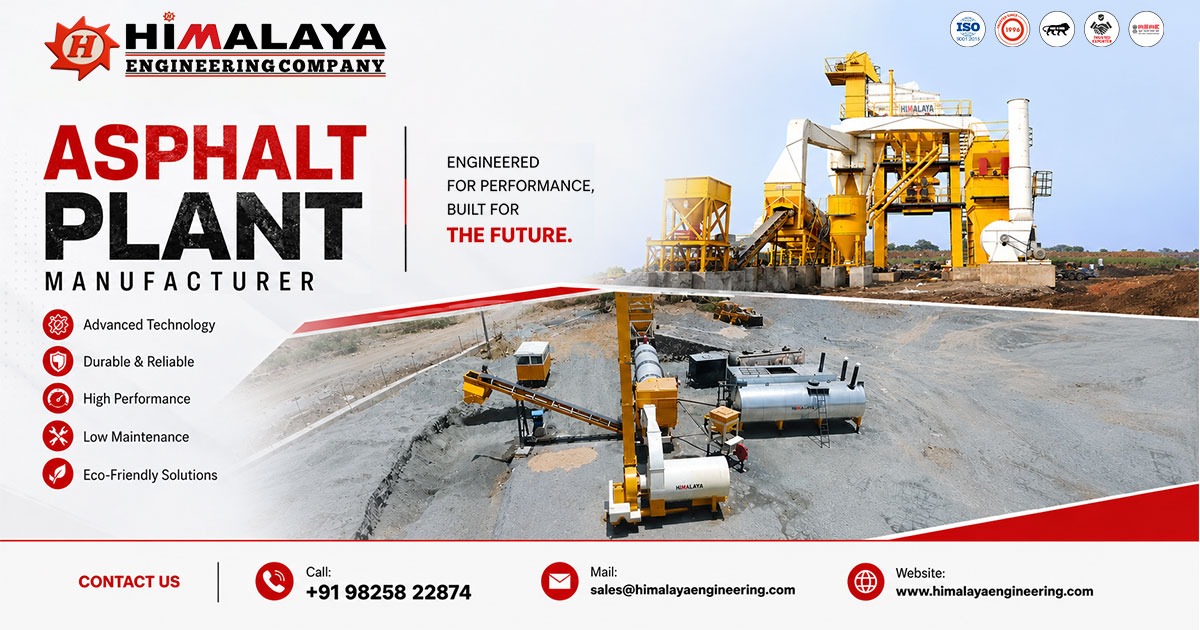
The quality of asphalt directly influences a road’s strength, finish, safety and service life. Choosing the right automatic asphalt plant manufacturer is therefore essential
for achieving consistent mix quality, reliable production and efficient project execution.
Himalaya Engineering Company manufactures automatic asphalt plants designed for controlled aggregate feeding, effective drying, accurate proportioning and uniform mixing.
With mobile and stationary configurations available, these plants can support projects ranging from rural roads to major highway developments.
We are based in Mehsana and Ahmedabad, with manufacturing in Mehsana, ensuring quality production and reliable delivery of road construction machinery.
Who Is Himalaya Engineering Company and What Do They Offer?
Established in 1997, Himalaya Engineering Company is an Indian manufacturer and exporter of road-construction machinery. Our company provides equipment engineered
for dependable performance, operational simplicity and demanding site conditions.
Its product portfolio includes:
- Automatic asphalt mix plants
- Asphalt batch mix plants
- Asphalt drum mix plants
- Mobile asphalt plants
- Stationary asphalt plants
- Wet mix macadam plants
- Paver finishers
- Bitumen-related equipment
- Road-construction machinery and supporting systems
- Customized plant configurations for specific project requirements
Himalaya Engineering Company supplies automatic plants with PLC-based controls, heavy-duty construction and multiple production configurations.
Its asphalt plants are used across India and in several international markets.
What Is the Capacity Range of Asphalt Plants?
Himalaya Engineering Company offers automatic asphalt plants with production capacities ranging from approximately 20 TPH to 240 TPH.
Available capacity depends on the plant type, layout and project requirements:
- 20–60 TPH: Suitable for small roads, maintenance work, remote locations and hilly terrain
- 80–120 TPH: Suitable for municipal roads, industrial areas and medium-sized infrastructure projects
- 160–200 TPH: Designed for highways and high-volume road-construction work
- 240 TPH: Suitable for large infrastructure projects requiring sustained asphalt production
We offer specific batch-plant configurations in higher-capacity variants. Select the ideal capacity based on your daily production targets, aggregate availability,
transportation distance, operating hours, and future expansion plans.
Types of Asphalt Plants
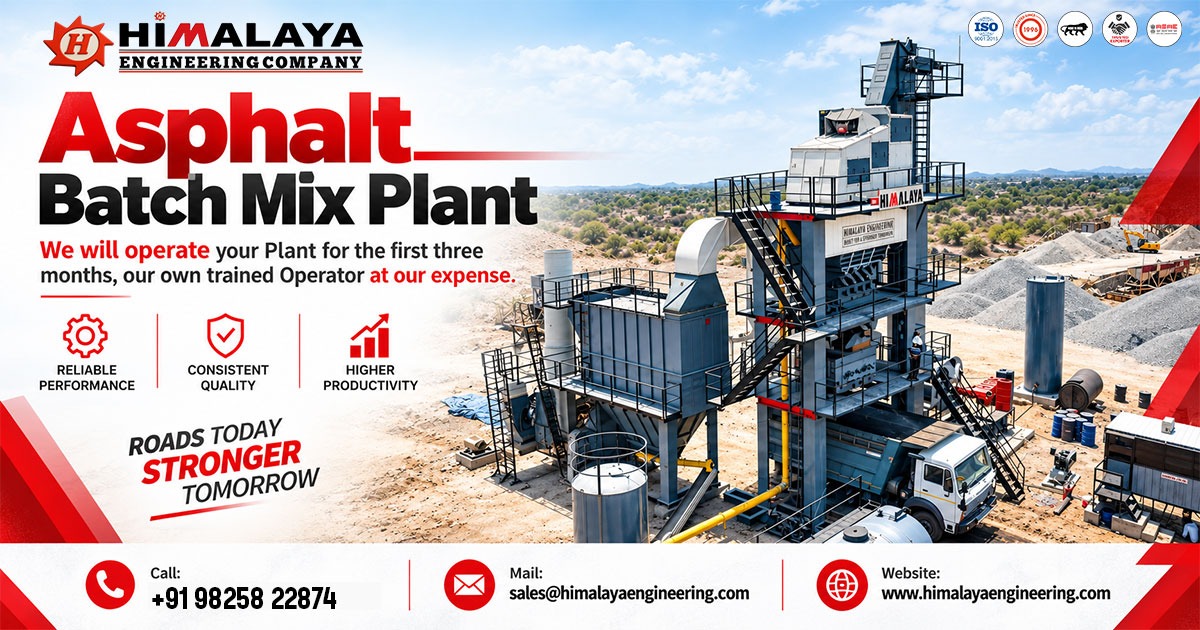
1. Automatic Asphalt Batch Mix Plant
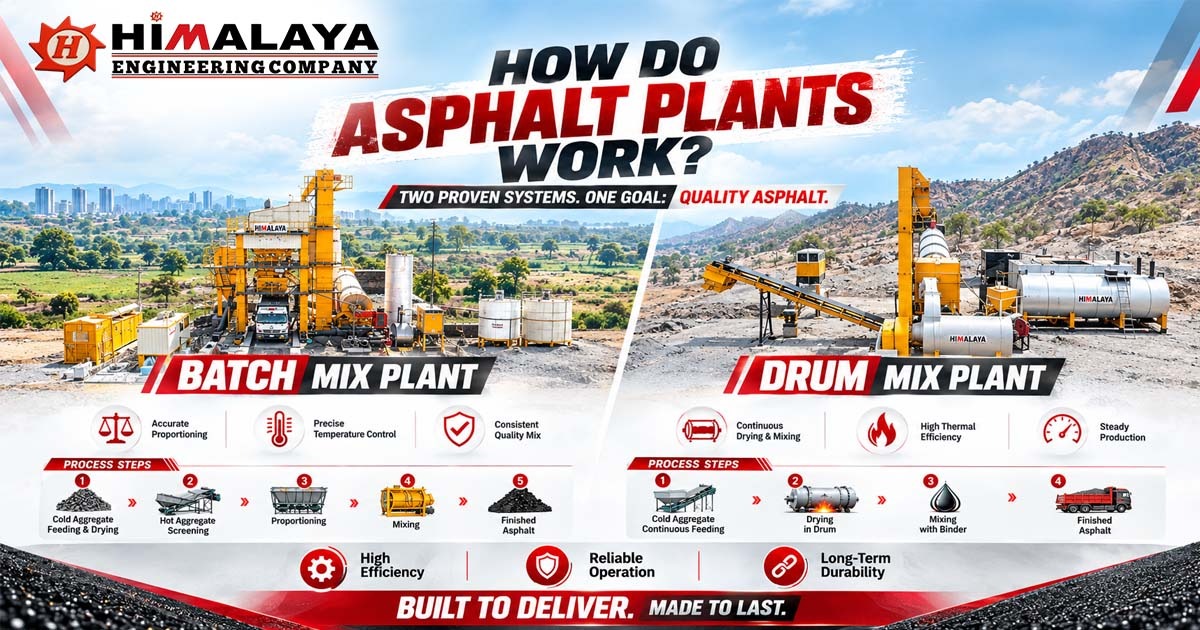
A batch mix plant produces asphalt in accurately measured batches. Aggregates, filler and bitumen are weighed separately before entering the mixer.
Key advantages include:
- Precise control over mix proportions
- Consistent asphalt quality
- Easy switching between mix recipes
- Accurate temperature monitoring
- Suitable for specification-driven projects
- PLC-controlled operation
Batch plants are ideal for highways, airport-related projects and applications requiring multiple asphalt grades.
2. Automatic Asphalt Drum Mix Plant
A drum mix plant produces asphalt through a continuous process. Aggregates are heated, dried and mixed with bitumen as they move through the drum.
Its benefits include:
- Continuous asphalt production
- Simple operating process
- Lower production interruptions
- Efficient output for large-volume work
- Economical operation and maintenance
- Compact plant arrangement
Drum mix plants commonly support highway construction, road widening, and projects that require uninterrupted material supply.
3. Mobile Asphalt Mix Plant
Manufacturers mount mobile asphalt plants on transportable chassis units, allowing operators to relocate them easily between project sites.
Its advantages include:
- Faster installation
- Easier transportation
- Reduced foundation requirements
- Suitable for short-duration projects
- Practical operation in remote locations
- Greater flexibility across multiple sites
Mobile plants are particularly useful for rural roads, hill roads, repair projects and contracts spread across several locations.
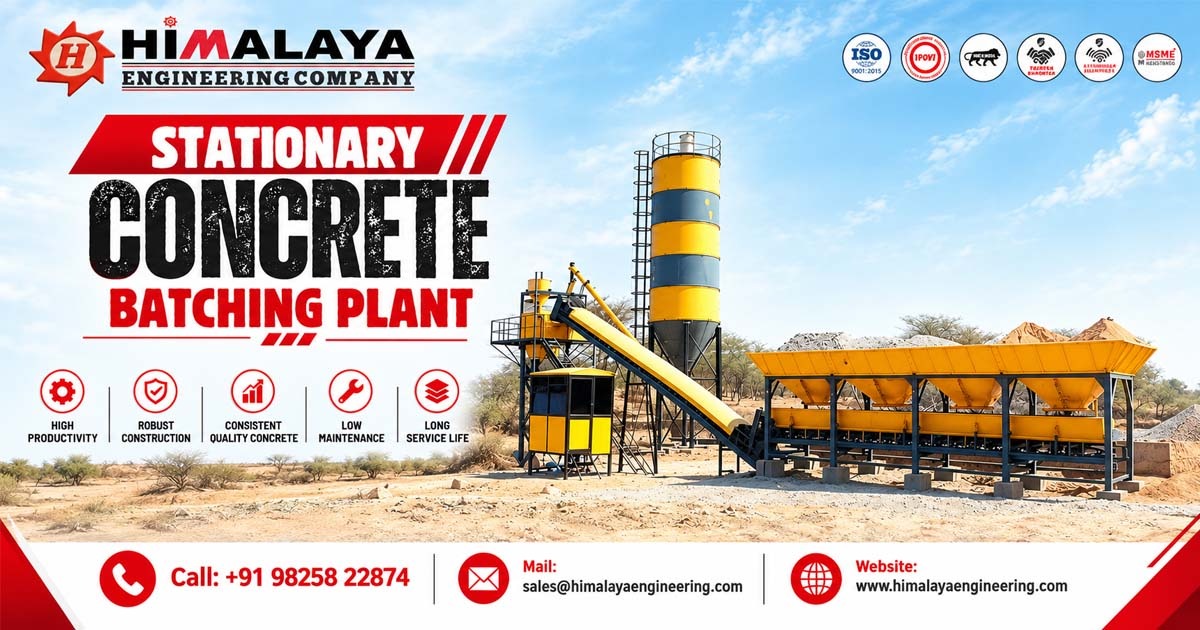
4. Stationary Asphalt Plant
A stationary plant operates at a fixed production facility and supports regular or long-term asphalt production.
Its major benefits include:
- Stable high-volume production
- Heavy-duty structural design
- Larger storage options
- Consistent output over extended shifts
- Integration with advanced dust-control systems
- Suitable for long-term infrastructure development
What Are the Main Components of an Automatic Asphalt Plant?
Cold Aggregate Feeding Bins
Gathering and Charging Conveyor
Drying Drum
Burner System
Dust-Collection System
Hot Aggregate Elevator
Vibrating Screen and Hot Bins
Weighing System
Mixing Unit
Bitumen Storage and Heating System
Mineral Filler System
Control Cabin and PLC Panel
Hot-Mix Storage or Discharge System
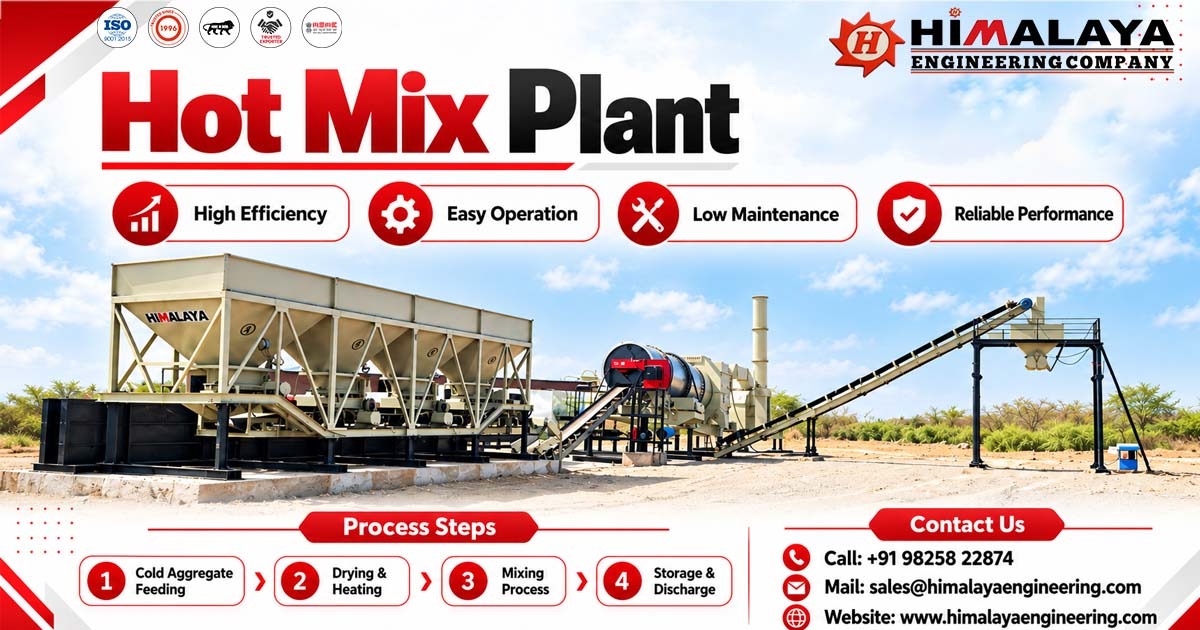
How Does an Asphalt Hot Mix Plant Work?
The production process follows a controlled sequence:
- Aggregate feeding: Operators load different aggregate sizes into separate cold-feed bins.
- Controlled proportioning: Feeder gates and conveyors release each aggregate in the required proportion.
- Drying and heating: Aggregates enter the rotating dryer, which removes moisture and heats the material to the required temperature.
- Dust collection: Dust-laden air passes through the plant’s pollution-control system, which captures particulate matter.
- Screening and storage: In a batch plant, the hot aggregate elevator lifts the heated aggregates, screens them by size, and stores them in hot bins.
- Accurate weighing: Aggregates, mineral filler and bitumen are measured according to the approved mix design.
- Uniform mixing: The measured materials enter the mixer and are blended for a preset duration.
- Quality monitoring: The PLC system monitors parameters such as temperature, material quantity and mixing time.
- Final discharge: The finished hot-mix asphalt is discharged into a tipper truck or temporary storage silo for transportation to the paving site.
In a continuous drum plant, drying and mixing occur continuously instead of through individually measured batches.
Applications of Automatic Asphalt Plants
Automatic asphalt plants are used for:
- National and state highway construction
- Expressway projects
- Urban and municipal roads
- Rural and village roads
- Hill roads and remote-area projects
- Airport runways and service roads
- Industrial and logistics parks
- Bridge approach roads
- Parking areas
- Residential and commercial developments
- Road widening and strengthening
- Asphalt resurfacing and rehabilitation
- Maintenance and repair projects
Frequently Asked Questions
Q1: What Is an Automatic Asphalt Plant?
An automatic asphalt plant is a production system that automatically controls aggregate feeding, heating, weighing, bitumen addition, mixing and asphalt discharge.
Q2: What Capacity Does Himalaya Engineering Company Offer?
Its automatic asphalt plant range is generally available from 20 TPH to 240 TPH, depending on plant type and configuration.
Q3: Which Plant Is Better: Batch Mix or Drum Mix?
A batch plant provides greater recipe flexibility and individual batch control. A drum plant supports economical, continuous production.
Q4: Can an Asphalt Plant Be Moved Between Sites?
Yes. Mobile asphalt plants are designed for easier transportation, installation and relocation between project locations.
Q5: What Materials Are Used to Produce Hot-Mix Asphalt?
The primary materials are graded aggregates, bitumen and mineral filler. The exact proportions depend on the approved mix design.
Q6: How Is Asphalt Quality Controlled?
Automated feeding, weighing, temperature monitoring and timed mixing help maintain consistent production. Routine material testing remains essential.
Q7: Where Are Automatic Asphalt Plants Commonly Used?
They are used for highways, city roads, rural roads, industrial roads, airport surfaces, parking areas and rehabilitation projects.
Automatic Asphalt Plant Supplier Across Uttar Pradesh
We supply automatic asphalt plants across Uttar Pradesh, including: Kanpur, Lucknow, Ghaziabad, Agra, Meerut, Varanasi, Prayagraj, Bareilly, Aligarh, Moradabad, Saharanpur, Gorakhpur, Noida, Firozabad, Jhansi, Muzaffarnagar, Mathura-Vrindavan, Ayodhya, Rampur, Shahjahanpur, Farrukhabad-Fatehgarh, Budaun, Maunath Bhanjan, Hapur, Etawah, Mirzapur-Vindhyachal, Bulandshahr, Sambhal, Amroha, Hardoi, Fatehpur, Raebareli, Orai, Sitapur, Bahraich, Modinagar, Unnao, Jaunpur, Lakhimpur, Hathras, Banda, Pilibhit, Barabanki, Khurja, Gonda, Mainpuri, Lalitpur, Etah, Deoria, Ghazipur, Sultanpur, Azamgarh, Bijnor, Sahaswan, Basti, Chandausi, Akbarpur, Ballia, Tanda, Greater Noida, Shikohabad, Shamli, Awagarh and Kasganj.
Choose Himalaya Engineering Company
Choose Himalaya Engineering Company today for a reliable asphalt plant engineered to power your next road project.
Company specifications referenced from Himalaya Engineering Company’s asphalt plant catalogue.
Phone No.: +91 9825822874
Email ID: sales@himalayaengineering.com
Website: www.himalayaengineering.com