Himalaya Engineering Company provides asphalt plant solutions designed to support road construction requirements through efficient material processing, consistent mixing, and dependable plant operation. Understanding how an asphalt drum mix plant works helps contractors select suitable equipment for their production capacity, project scale, and site conditions.
Overview of Asphalt Drum Mix Plant
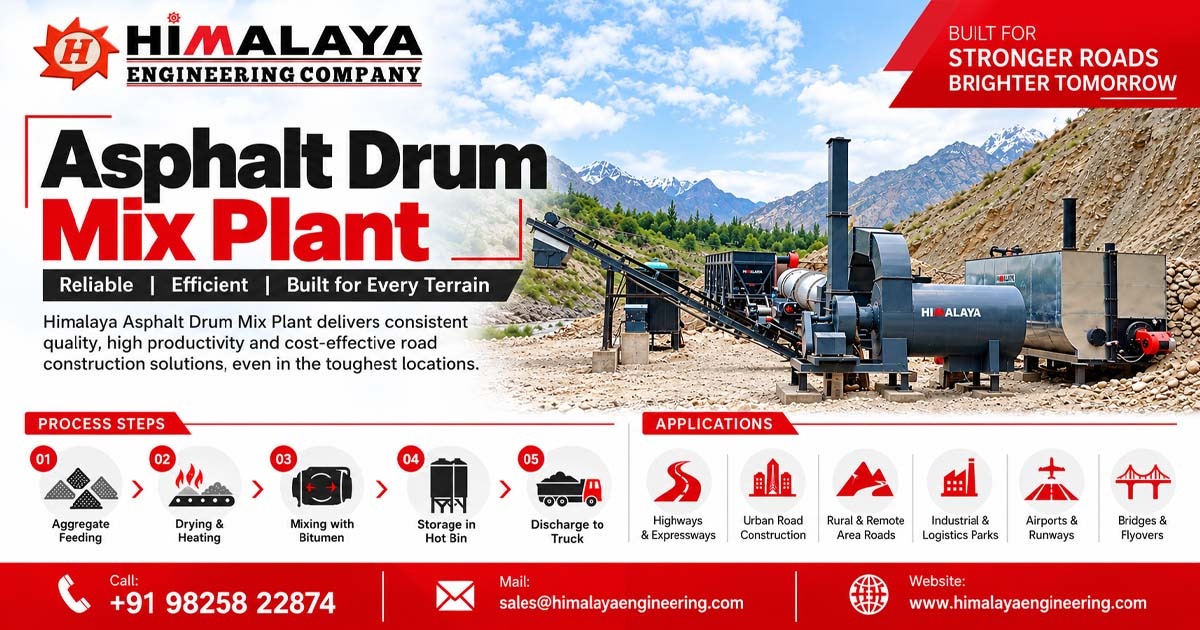
An asphalt drum mix plant is a continuous asphalt production system that combines aggregate drying, heating, bitumen addition, and mixing within a rotating drum. Unlike a batch mix plant, which produces asphalt in separate batches, a drum mix plant generally manufactures hot mix asphalt continuously while materials are fed into the system.
Functions of an Asphalt Drum Mix Plant
- Aggregate Feeding: Supplies different sizes of aggregates in controlled proportions.
- Aggregate Drying: Removes moisture from aggregates using heat generated by the burner.
- Aggregate Heating: Raises aggregate temperature to the level required by the production process.
- Bitumen Addition: Introduces heated bitumen into the mixing system.
- Mixing and Coating: Blends aggregates with bitumen to create a uniform asphalt mixture.
- Fume and Dust Management: Uses pollution-control equipment to capture dust and manage exhaust gases.
- Hot Mix Discharge: Transfers the finished asphalt mixture for transportation and road paving.
How Drum Mix Plant Works Step by Step
An asphalt drum mix plant follows a continuous production sequence, from feeding raw materials to discharging the finished asphalt mixture.
1. Aggregate Feeding Through Cold Feed Bins
- Operators store different aggregate sizes separately in cold feed bins.
- Each bin supplies material to a conveyor system.
- Feeder speeds regulate the flow of aggregates according to the required mix proportions.
- Correct aggregate proportioning supports consistent asphalt quality.
2. Aggregate Conveying and Screening
- Conveyors transport aggregates from the cold feed bins toward the drying drum.
- The feeding system maintains a steady supply of material.
- Depending on the plant design, operators may use additional screening or material-sizing systems.
3. Drying and Heating Inside the Drum
- Aggregates enter the rotating drum, where they are exposed to heat from the burner.
- Drum rotation moves the material through the heating zone.
- Flights or lifting blades lift and cascade aggregates to improve heat transfer.
- Moisture evaporates, and aggregates reach the required processing temperature.
4. Bitumen Addition and Mixing
- Heated bitumen is delivered through a controlled pumping system.
- The bitumen is introduced at the designated mixing zone.
- Aggregates and bitumen combine to form a coated asphalt mixture.
- Mixing conditions are adjusted to achieve the specified mix design and coating quality.
5. Dust Collection and Exhaust Management
- Exhaust gases from the drum pass through the plant’s dust-control system.
- A dust collector, commonly a bag filter, captures airborne particulate matter.
- Collected dust may be handled or reused according to the plant design, mix requirements, and applicable environmental regulations.
6. Hot Mix Asphalt Discharge
- The finished asphalt mixture exits the drum through the discharge system.
- The mixture is transferred to a storage arrangement, loading point, or transport vehicle, depending on the plant configuration.
- Trucks carry the hot mix to the road construction site for spreading and compaction.
7. Quality Control and Continuous Operation
- Operators monitor aggregate feed rates, bitumen flow, temperatures, and production output.
- The control system helps maintain the required operating parameters.
- Regular inspection and calibration support reliable performance and consistent mix quality.
Main Components of a Drum Mix Plant
Each component contributes to the plant’s ability to produce hot mix asphalt efficiently.
- Cold Feed Bins: Store and supply aggregates in the required proportions.
- Rotary Drying and Mixing Drum: Supports aggregate drying, heating, and mixing according to the plant design.
- Burner System: Supplies the heat required to dry and heat aggregates.
- Bitumen Storage and Pumping System: Stores, heats, and delivers bitumen to the mixing zone.
- Dust Collection System: Captures dust from the exhaust stream.
- Control Panel and Automation System: Helps operators monitor and regulate production parameters.
- Discharge and Material Handling System: Transfers the finished asphalt mixture for loading and transportation.
Drum Mix Plant Working Principle Explained Simply
The working principle of an asphalt drum mix plant is based on continuous material feeding, heat transfer, controlled bitumen addition, and mechanical mixing.
The process can be understood in five basic stages:
1. Feed
Aggregates of different sizes enter the system in the required proportions.
2. Heat
A burner supplies heat while the rotating drum helps dry and heat the aggregates.
3. Mix
Bitumen is introduced into the designated zone and mixed with the aggregates.
4. Control
Sensors, controls, and dust collection equipment support process monitoring and emission management.
5. Discharge
The finished hot mix asphalt leaves the plant for transportation and paving.
Frequently Asked Questions
Q1: How Does an Asphalt Drum Mix Plant Work?
An asphalt drum mix plant feeds aggregates into a rotating drum, dries and heats them using a burner, adds bitumen in a designated mixing zone, and discharges the finished asphalt mixture.
Q2: What Are the Main Components of a Drum Mix Plant?
The main components include cold feed bins, conveyors, a rotary drum, burner, bitumen pumping system, dust collector, control panel, and discharge arrangement.
Q3: What Is the Difference Between a Drum Mix Plant and a Batch Mix Plant?
A drum mix plant generally produces asphalt continuously, while a batch mix plant produces separate batches using individual material weighing and mixing cycles.
Q4: Where Are Asphalt Drum Mix Plants Used?
They are used for highway construction, urban roads, rural roads, industrial access roads, resurfacing, and other infrastructure projects requiring hot mix asphalt.
Q5: How Do I Choose the Right Asphalt Drum Mix Plant?
Consider the required production capacity, aggregate moisture, fuel consumption, mix specifications, dust-control system, automation, installation conditions, and available technical support.
Asphalt Drum Mix Plant Supplier in Madhya Pradesh
Himalaya Engineering Company supplies asphalt drum mix plant solutions for road construction projects across Madhya Pradesh. Contractors, infrastructure developers, and road construction companies can explore suitable plant configurations based on production requirements, project specifications, and site conditions.
Locations We Serve in Madhya Pradesh
We supply asphalt drum mix plants in the following cities and industrial locations: Indore, Bhopal, Jabalpur, Gwalior, Ujjain, Sagar, Dewas, Satna, Ratlam, Rewa, Katni,
Singrauli, Burhanpur, Morena, Khandwa, Bhind, Chhindwara, Guna, Shivpuri, Vidisha, Chhatarpur, Damoh, Mandsaur, Khargone, Neemuch, Pithampur, Narmadapuram,
Itarsi, Sehore, Betul, Seoni, Datia, Nagda, and Shahdol.
Contact Himalaya Engineering Company
Upgrade your road construction capabilities with Himalaya Engineering Company’s asphalt plant solutions, designed to support efficient material processing, reliable operation, and consistent hot mix asphalt production.
- Phone: +91 9825822874
- Email: sales@himalayaengineering.com
- Website: www.himalayaengineering.com
Contact Himalaya Engineering Company to discuss your asphalt drum mix plant requirements and identify a suitable solution for your next road construction project.
View Product: Click here